Limited liability partnership (LLP) Registration
Limited liability partnership (LLP) Registration
Limited liability Services
Explore LLP Registration services in Bangalore. Learn about eligibility criteria, required documents, and benefits of LLP registration. Contact BC Shetty & Co. for hassle-free LLP incorporation now!
What is an LLP?
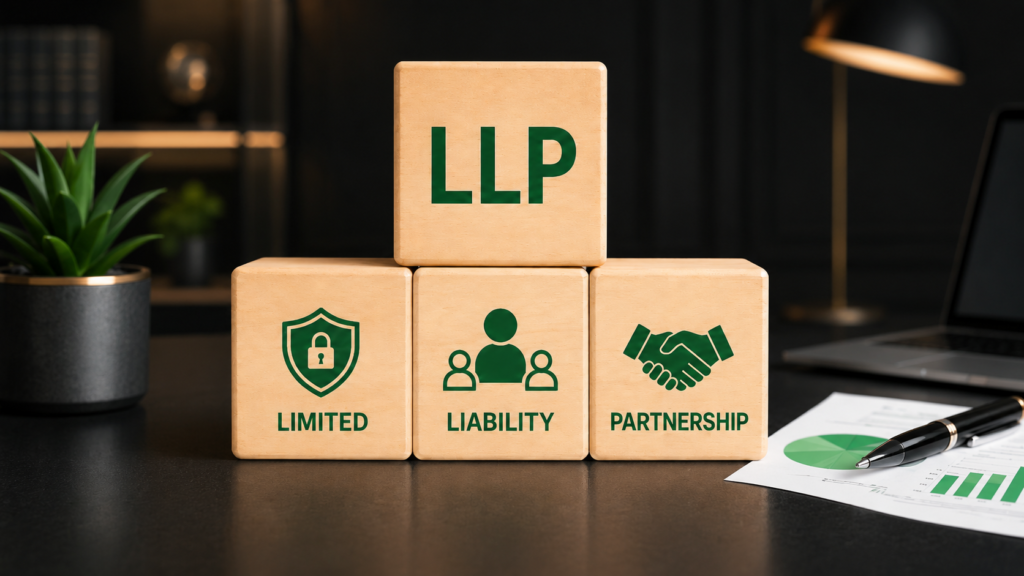
A Limited Liability Partnership (LLP) combines the flexibility of a partnership with the limited liability protection of a company. It has a separate legal identity and protects partners’ personal assets from business liabilities.
The partners’ roles, responsibilities and profit-sharing terms are defined through an LLP Agreement. LLPs are suitable for professionals, startups and service-based businesses.
Vagrecha & Associates provides complete assistance for LLP registration and compliance.
Eligibility Criteria for LLP Registration
It is mandatory to comply with the following criteria during the LLP registration: es.
Minimum two partners are required.
At least two designated partners must be appointed.
At least one designated partner must be a resident of India.
There is no minimum capital requirement.
A valid registered office address is required.
The proposed LLP name must be unique and approved.
Each designated partner must obtain a Digital Signature Certificate (DSC).
The business must be formed for a lawful, profit-oriented purpose.
Documents for incorporation of LLPS
Registered office Address for LLP
- Email address and contact number of each designated partner
- Explanation or significance of the proposed LLP name
- Total capital contribution and contribution percentage of each partner
- Proof of registered office address, such as a recent utility bill, gas bill or rent agreement
- Identity proof and address proof of all designated partners, duly signed
- Consent letters signed by the designated partners
- Subscription sheet signed by all partners
- LLP Agreement to be prepared and filed with the Registrar of Companies within the prescribed period
- Duration of stay at the current residential address
- Place of birth of each partner
- Educational qualifications of the partners
- Occupation or professional details of the partners
- Digital Signature Certificate (DSC) of each designated partner; assistance can be provided if it is not available
Accepted Identity Proof
- Driving Licence
- Voter ID Card
- Passport
Accepted Address Proof
- Bank Statement
- Electricity Bill
- Telephone Bill
- Mobile Bill
Step-by-Step LLP Incorporation Process
Step-by-Step LLP Incorporation Process
Obtain a Digital Signature Certificate (DSC)
A DSC is required for all designated partners to digitally sign and submit LLP registration documents.
Apply for DIN/DPIN
Designated partners must obtain a Director Identification Number or Designated Partner Identification Number. It can be applied for through the LLP incorporation form.
Reserve the LLP Name
Submit the proposed LLP name through the MCA portal. The name must be unique and compliant with applicable naming guidelines.
File the LLP Incorporation Form
Submit Form FiLLiP with details of the partners, registered office address, business activity and capital contribution.
Receive the Incorporation Certificate
After approval, the Registrar of Companies issues the Certificate of Incorporation along with the LLP Identification Number. PAN and TAN are also allotted.
Draft and File the LLP Agreement
Prepare the LLP Agreement defining the partners’ roles, responsibilities, contribution and profit-sharing ratio. It must be filed within the prescribed period.
Open the LLP Bank Account
Open a current bank account using the incorporation certificate, PAN and LLP Agreement. The partners can then deposit their agreed capital contribution.
Advantages & Disadvantages of LLP
Advantages
- Partners’ personal assets are protected through limited liability.
- An LLP can have any number of partners.
- Compliance requirements are generally simpler than those of a private limited company.
- Profit distribution to partners is not subject to dividend distribution tax.
- Eligible LLPs may receive Foreign Direct Investment, subject to applicable regulations.
Disadvantages
- LLPs may be less attractive to equity investors compared to companies.
- Ownership cannot be transferred as easily as company shares.
- LLPs must maintain regular statutory filings and compliance.
- Fundraising options may be more limited than those available to private limited companies.